We use cookies to personalise content, to provide social media features, and to analyse our traffic. By choosing 'allow all cookies', you consent to our cookies.
To find out more, read our privacy policy and cookie policy.
The DECIDE cattle group developed data-driven tools to support farmers, veterinarians and animal health stakeholders in preventing, detecting and controlling calf diseases, with a particular focus on Bovine Respiratory Disease (BRD). BRD is one of the most costly diseases affecting cattle in Europe. Predicting disease outbreaks helps veterinarians and farmers take preventive action.
Key outputs include the Cattle Barometer, the Purchase Assistant and Connect’BRD. The cattle group also advanced privacy-preserving disease prediction through a Federated Learning System linked to the Cattle Barometer, enabling laboratories to collaborate without sharing raw data. In addition, DECIDE quantified the welfare impact of BRD in dairy calves to support better prioritisation of health problems on the farm. Together, these outputs provide practical tools and evidence to improve cattle disease surveillance, early warning, purchasing decisions, intervention planning and welfare-based herd health management.
Tools
Cattle Barometer
An interactive dashboard was developed to visualise pathogen-specific laboratory results from cattle respiratory tract samples. It allows users to explore historical trends, regional differences and the current presence of bovine respiratory disease pathogens. By presenting data across time, geography and diagnostic tests, the tool supports farmers, veterinarians and laboratories in interpreting disease dynamics and considering timely control measures, such as vaccination, additional testing or quarantine when purchasing animals.
Objective: To improve visibility of cattle respiratory pathogen circulation and support early warning and decision-making for disease control.
Key features
Visualises pathogen-specific laboratory results.
Shows temporal trends, geographical distribution and diagnostic test information.
Includes data from Belgium, the Netherlands and Ireland.
Supports decisions on vaccination, testing and quarantine.
Designed to become more continuous.
Target users: Farmers, veterinarians, veterinary laboratories and cattle health advisors.
Developed for the Cattle Barometer surveillance platform to improve disease prediction without requiring laboratories to share sensitive diagnostic data. Each laboratory trains a model locally using its own data, while only learned patterns are shared and combined into a global model. Tested with six laboratories in Belgium, France, Ireland and the Netherlands, the system supports broader collaboration while preserving privacy and data ownership.
A decision-support tool developed by the Swedish Veterinary Agency within DECIDE. It addresses the risk of introducing infections when buying cattle from other herds by providing information on herd health status and helping match buying and selling herds according to selected health criteria. The tool was developed through a co-creative, iterative process with the Swedish Board of Agriculture and cattle stakeholders.
Objective: To reduce the risk of introducing cattle diseases through animal purchases and to support safer trade between herds.
Key features
Provides a risk estimate for introducing specific pathogens when buying cattle.
Offers lists of matching herds according to selected health status criteria.
Allows users to check health status before buying.
Includes functions for viewing own laboratory results and entering animals for sale.
Target users: Cattle farmers, veterinarians, cattle stakeholders and herd health advisors.
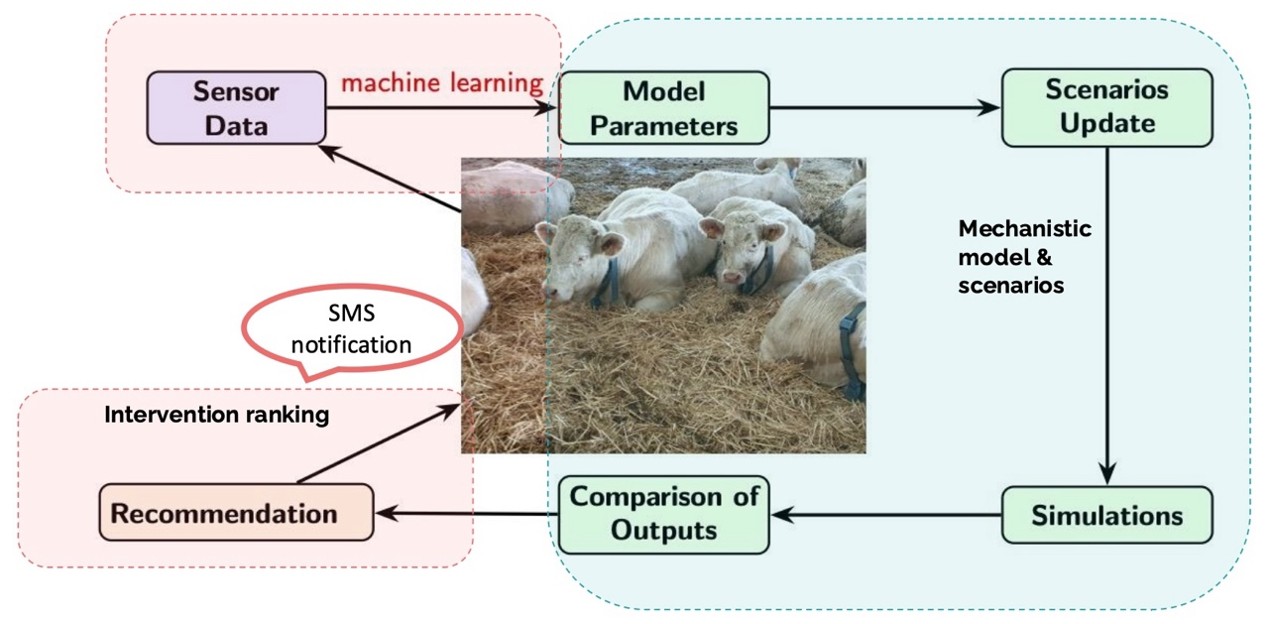
An early detection and decision-support tool developed by INRAE to help farmers and veterinarians manage bovine respiratory disease in young beef cattle. The tool combines behavioural data from on-farm activity sensors with artificial intelligence and mechanistic models that predict disease spread. It identifies animals potentially at risk, simulates intervention scenarios such as treatment, isolation or additional monitoring, and sends SMS notifications with suggested actions.
Objective: To detect BRD earlier and support more targeted interventions, reducing disease impact and supporting responsible antimicrobial use.
Key features
Monitors behaviour such as eating, resting and rumination.
Applies AI-based models to detect animals at risk.
Simulates intervention scenarios for BRD control.
Ranks interventions based on animal health outcomes and antimicrobial use.
Sends notifications identifying animals at risk.
Target users: Cattle farmers and veterinarians.
Access and resources
Public tool: on-farm testing finished; tool to be available