
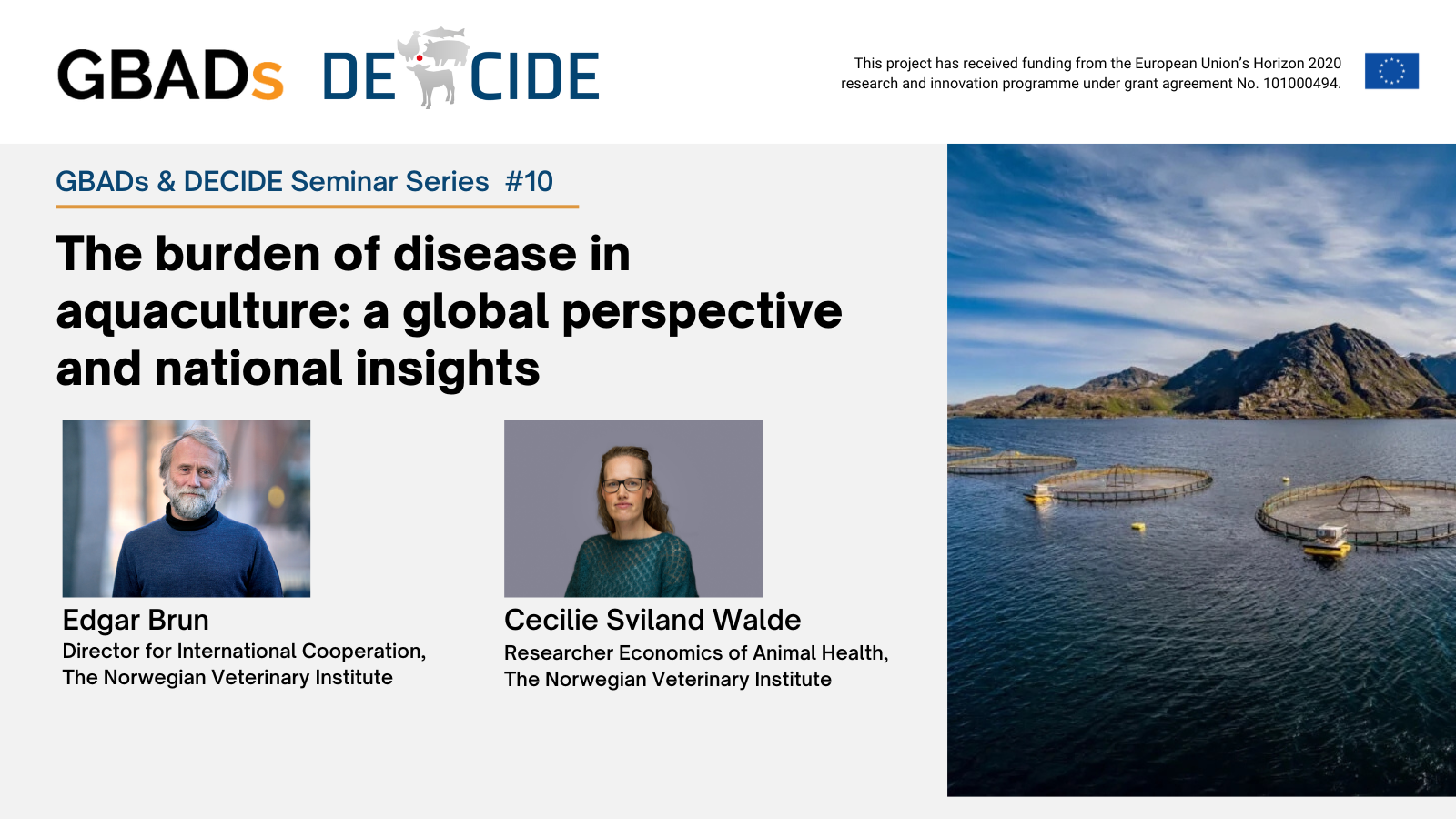
The webinar was opened and moderated by Jonathan Rushton (University of Edinburgh, Director of GBADs), who highlighted the growing importance of aquaculture in global food production and the need for robust economic and epidemiological evidence to support effective animal health governance.

Global and national perspectives on aquaculture health
The first presentation was delivered by Edgar Brun, a renowned veterinarian and expert in fish health and welfare at the Norwegian Veterinary Institute. Brun provided a global overview of aquaculture as a rapidly expanding livestock sector, now supplying more aquatic food for human consumption than capture fisheries. He emphasised that while aquaculture has delivered major gains in food security, livelihoods and climate-friendly protein production, intensification has also increased biological and environmental pressures.
“Aquaculture has been a great success economically and socially, but if we only look at this success, we risk missing the negative sides of production,” Brun noted. “We still lack a clear and comprehensive understanding of the true economic burden of disease in aquaculture, even though its impacts are likely substantial.”
Brun underlined that existing estimates of disease-related losses are fragmented and often fail to capture wider societal and environmental effects, particularly in low- and middle-income countries. Initiatives such as GBADs, he argued, are essential to generate comparable, transparent evidence and to support sustainable aquaculture within a One Health framework.

The global perspective was followed by a national case study presented by Cecilie Sviland Walde, a researcher specialising in the economics of animal health, also at the Norwegian Veterinary Institute. Her presentation focused on pancreas disease (PD) in Norwegian salmon farming, using economic theory to frame disease control as a collective action dilemma.
Drawing on recent PD outbreaks outside endemic areas, Walde showed how mandatory depopulation can protect the wider production area but impose substantial short-term losses on individual farms. Preliminary results from combined epidemiological and economic modelling demonstrated that rapid depopulation delivers clear net benefits at the regional level, while delays can result in very high overall costs due to disease spread and reduced fish performance. However, individual incentives may still favour postponement, raising questions about responsibility, fairness and compensation.
“What we observe is not necessarily unwillingness to act,” Walde added, “but uncertainty about how responsibility and costs should be shared once collective action is taken.”
Both Edgar Brun and Cecilie Sviland Walde are members of the World Organisation for Animal Health (WOAH) Collaborating Centre for the Economics of Animal Health, Europe Region, reinforcing the webinar’s strong scientific and policy relevance.

Key messages and conclusions
The discussion highlighted several cross-cutting challenges relevant well beyond the Norwegian context:
- the need for credible economic evidence to inform disease control decisions and public policy,
- the importance of trust, data sharing and collective mechanisms in managing disease risks in highly interconnected production systems,
- and the role of institutional arrangements, including compensation schemes, in aligning individual incentives with societal benefits.
The event concluded by encouraging participants to explore the outcomes of the DECIDE project and to continue engagement through upcoming meetings and GBADs activities, as the need for evidence-based, cooperative approaches to animal health governance becomes ever more pressing. The recording of the webinar will be made available shortly on the DECIDE YouTube channel.
Stay tuned for updates and further opportunities to engage with DECIDE and GBADs activities, as evidence-based and cooperative approaches to animal health governance become increasingly critical.